

Tired of KOHA? Discover a Smarter, Faster Library Management System Software BookBolt
In today’s digital education environment, library software plays an important role. It helps turn traditional libraries into efficient, technology-based knowledge centers. Many institutions are now using digital systems. Because of this, modern library software is replacing manual registers and old processes.
With a single digital platform, libraries can manage cataloging, book circulation, inventory, and user access. This makes daily work simple and well organized.
Modern library software also allows faster book searches. Users can check real-time availability and place online reservations. Features like automated alerts and smooth issue–return processes reduce manual work. Barcode and RFID technology make these tasks quicker and more accurate.
These benefits are not limited to library staff. Students, teachers, and researchers get faster access to resources and an easy-to-use system. In the end, libraries become smarter, more efficient, and ready for the future.
Better alternatives to KOHA
Many institutions now look for better alternatives to KOHA. Modern library software offers a more user-friendly experience. These systems are easy to customize and quicker to deploy. They also provide faster technical support and follow local compliance needs. Unlike complex open-source platforms, they require less technical effort. This makes training and maintenance simple. As a result, institutions can focus more on academics instead of software issues.
The best library software for NAAC focuses on digital records and OPAC access. It also provides clear usage data and ready-to-use reports. These reports support audits and accreditation requirements. Because of this, institutions improve transparency and governance. In the long run, NAAC-ready library software helps achieve better scores and supports modern digital learning environments.
Semi-automated and fully automated libraries.
This guide gives institutions a clear and practical path to library automation. It first explains what a library management system is. It also covers key automation methods, such as barcode and RFID systems.
Next, the guide shows how semi-automated and fully automated libraries improve daily work. These systems support teaching and learning. They also reduce manual effort and improve efficiency.
Most importantly, the guide explains how library automation affects NAAC assessment. It highlights digital records, OPAC access, usage data, and audit-ready reports. These features help institutions meet accreditation needs.
Finally, the guide compares popular library software options. These include Koha, LibSenslie, BookBolt, LibSys, eMster, SLiMS, and SOUL. This comparison helps institutions choose the right solution based on budget, size, and long-term digital plans.
👉 Ideal for colleges and universities planning NAAC-aligned digital transformation.
Empower your institution with a reliable library management system trusted by modern academic libraries.
What is Library Management System Software?
Library Management System (LMS) Software is a specialized solution that digitally handles all library operations. Instead of manual registers, card systems, and paper-based workflows, it provides a centralized digital platform for efficient management.
With an LMS, librarians can easily manage:
Book acquisition and cataloging
Issue and return operations
Member management
Inventory and stock verification
Fine calculation
Reports and analytics
Moreover, modern LMS solutions are web-based, cloud-ready, and accessible from multiple devices. As a result, librarians, students, faculty, and administrators can seamlessly coordinate and access resources anytime, anywhere.
What is Library Automation?
Library automation means using software and hardware to manage daily library work. It automates tasks like book issue and return, catalog search, stock checking, fine calculation, and report creation.
Library automation makes work faster and more accurate. It reduces manual errors and saves time. It also helps libraries use their resources better. Based on the level of technology used, library automation is classified into the following types:
- Semi / Partially Automated Libraries
- Fully Automated Libraries
Types of Library Management Software Connectivity
Modern library management software connects physical books with digital records using identification technologies. The two most common technologies are:
- Barcode / QR Code Technology
- RFID Technology
Barcode and QR Code Technology in Library Management
Barcode and QR code–based library automation is the most widely adopted and cost-effective solution, especially for schools, colleges, and small to mid-sized institutions.
How Barcode / QR Code Technology Works
Each book is assigned a unique barcode or QR code label. Library members are issued ID cards with barcodes or QR codes. During issue or return, the librarian scans both the book code and the member card, and the LMS updates records instantly.
Key Features of Barcode / QR Code Library Systems
- Unique identification for every book and member
- Fast issue and return process
- Accurate circulation records
- Automatic fine calculation
- Easy inventory management
- Low implementation cost
Advantages of Barcode / QR Code Technology
- Affordable and easy to implement
- Low maintenance cost
- Minimal training required
- Compatible with most LMS platforms
Limitations of Barcode / QR Code Technology
- Manual scanning required
- Inventory verification is time-consuming
- Limited security without additional hardware
RFID Technology in Library Management
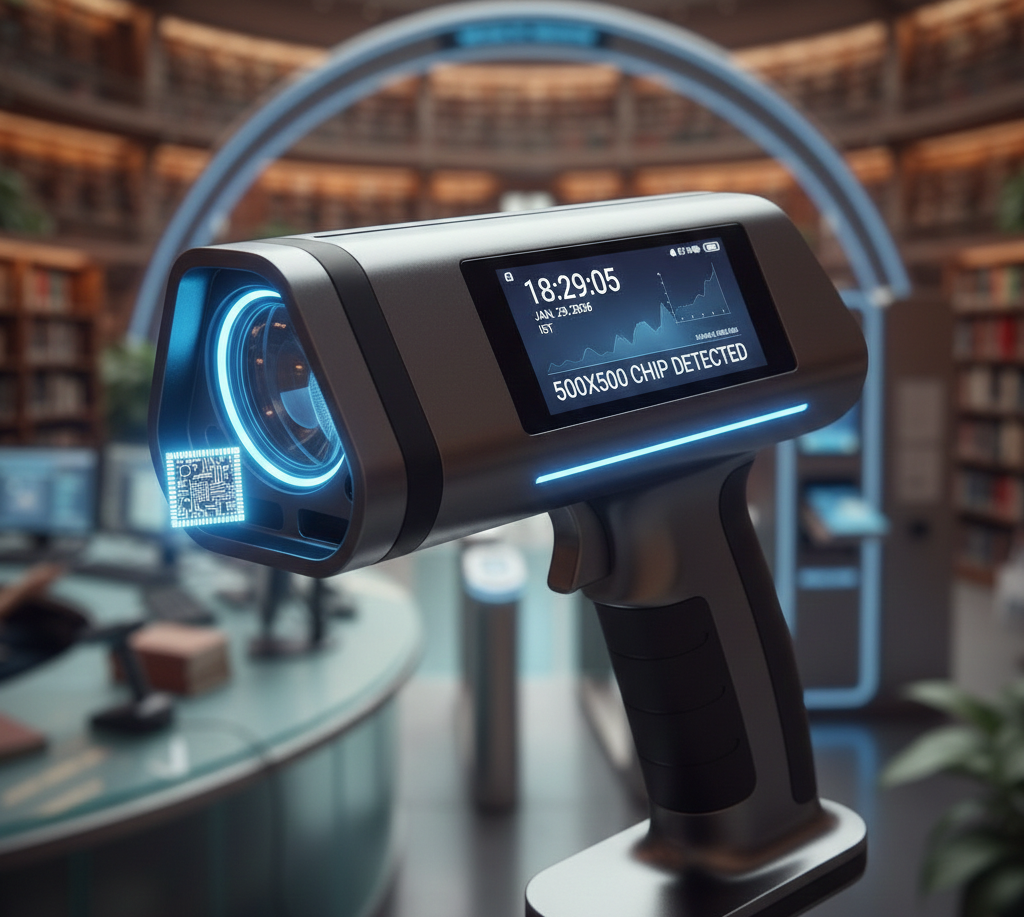
RFID (Radio Frequency Identification) technology represents advanced library automation used in large universities, government libraries, and research institutions.
How RFID Technology Works
Each book contains an RFID tag. RFID readers communicate wirelessly with these tags, allowing issue, return, and inventory without direct line-of-sight scanning.
Key Components of RFID Library Automation
- RFID tags for books
- RFID reader pads
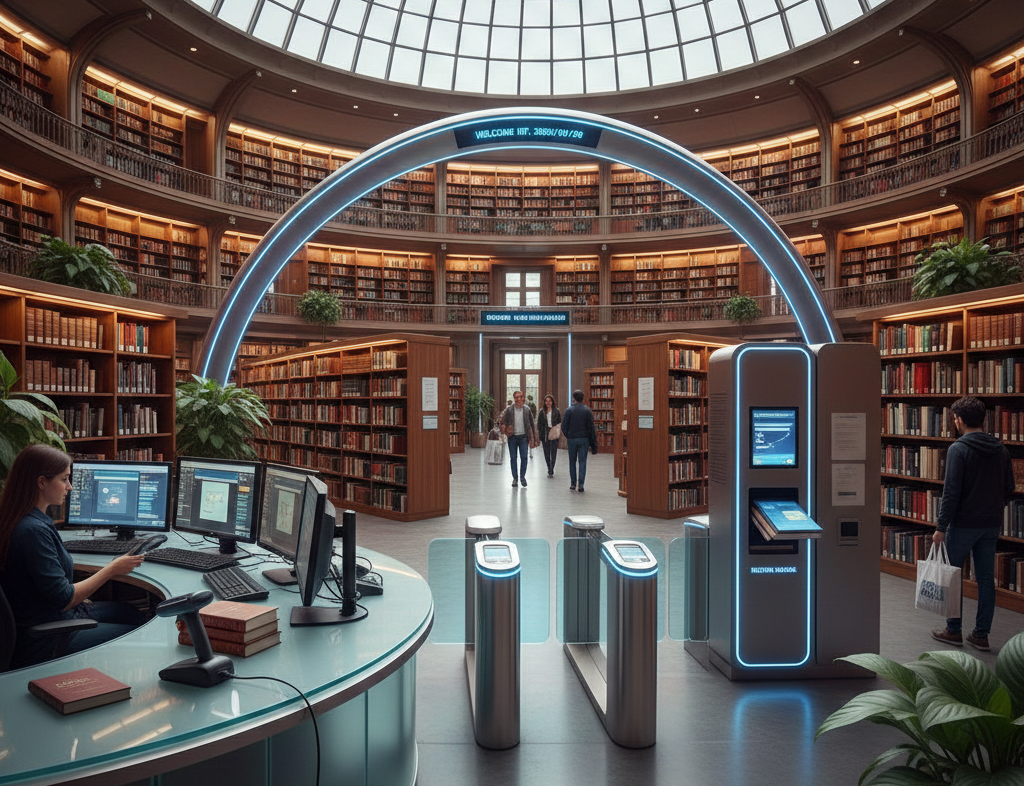
- Security gates
- Self-issue and self-return kiosks
- RFID middleware integrated with LMS
Advantages of RFID-Based Library Automation
- Multiple books processed simultaneously
- Fast inventory verification
- Enhanced theft protection
- Reduced manpower dependency
Limitations of RFID Technology
- Higher initial cost
- Requires technical expertise
- Hardware maintenance needed
Types of Library Automation
Semi / Partially Automated Library
Uses LMS with barcode or QR code technology. Human involvement is required, but records are digitized. Common in schools and colleges.
Fully Automated Library
Integrates LMS with RFID, self-service kiosks, and security systems. Users can issue and return books independently.
Workflow of Semi-Automated (Barcode / QR Code) Library
- Book entry and cataloging
- Member registration
- Book search via OPAC
- Issue process
- Return process with auto fine calculation
- Inventory management
- Reports and analytics
Workflow of Fully Automated (RFID-Based) Library
- RFID tagging and LMS integration
- Self-service issue and return
- Automated security gates
- Rapid inventory verification
- Real-time data synchronization
- Advanced dashboards and reports
Benefits of Library Automation
For Students and Users
- Faster access to books
- Online search and reservations
- Reduced waiting time
- Transparent fine tracking
For Librarians
- Reduced manual workload
- Error-free transactions
- Easy report generation
- Better resource management
For Institutions
- Improved efficiency
- Better asset utilization
- Enhanced institutional image
- NAAC compliance
Role of Library Automation in NAAC Scoring
Library automation helps improve NAAC performance. This is most important under Criterion 4 – Infrastructure and Learning Resources. A modern library system shows that an institution supports digital learning and quality education.
Under this criterion, NAAC checks how well the library supports teaching, learning, and research. Automation makes this work easier. It provides OPAC access, digital issue–return records, e-resources, and clear usage data. This improves access and helps raise qualitative scores.
NAAC also values transparency and efficient management. Library automation supports this with clear reports and records. The system generates circulation data, inventory details, and user statistics. As a result, institutions improve governance, reduce manual work, and build strong trust during NAAC peer reviews.
Documentation and Compliance Advantage
One major benefit of library automation is easy access to NAAC-ready documents. Automated library systems can quickly generate reports on book issues, user visits, and resource usage. They also provide year-wise growth data.
This reduces manual work and improves accuracy. As a result, institutions are better prepared for the NAAC accreditation process.
Popular Library Management Software
- Koha
- Koha is a globally used open-source library management system that offers complete automation of cataloging, circulation, acquisitions, and OPAC. It supports barcode and RFID integration and is highly customizable, making it suitable for universities and institutions with technical support teams.
- BookBolt is an ERP-integrated Indian library solution that connects library operations with student and staff management systems. It simplifies circulation, reporting, and data synchronization, making it suitable for institutions already using ERP software.
- LibSys
- LibSys is a trusted enterprise-level LMS widely used in large universities and government libraries. It supports advanced automation, RFID integration, and high-volume transactions, offering long-term stability and vendor support.
- eMaster
- eMaster is a cost-effective library management software suitable for small schools and colleges. It provides essential features like barcode-based circulation, cataloging, and basic reporting with minimal infrastructure requirements.
- SLiMS
- SLiMS (Senayan Library Management System) is a lightweight open-source LMS known for its simplicity and low hardware needs. It is ideal for small libraries and institutions seeking affordable library automation.
- SOUL
- SOUL (Software for University Libraries) is developed by INFLIBNET for Indian universities. It supports academic workflows and aligns with UGC and NAAC standards, making it a preferred choice for higher education institutions.
Barcode vs RFID: Comparative Overview
Barcode systems are affordable and simple, while RFID systems offer speed, security, and scalability. The choice depends on budget, library size, and institutional goals.
What are best alternative software of koha /soul/ libsys?
What are best Alternative of KOHA?
Institutions seeking an alternative to KOHA often look for a solution that reduces technical complexity while improving usability and performance. While KOHA is powerful, it requires strong server management and technical expertise. Modern library management systems like BookBolt provide a simplified, web-based interface with faster deployment, built-in barcode/RFID support, seamless OPAC access, and automated reports, making them a practical choice for colleges and universities that want reliability without heavy IT dependency.
What are best Alternative of SOUL?
As an alternative to SOUL, many libraries now choose modern library software. These platforms offer more flexibility, a clean user interface, and cloud support. SOUL is common in academic libraries, but it has limits. Customization and scalability are often difficult.
New library systems provide real-time data access. They make cataloging simple and circulation smooth. They also generate NAAC- and accreditation-ready reports. This helps libraries move toward a more efficient digital setup.
Best alternatives to SLiMS
As an alternative to SLiMS, institutions look for software that is flexible and easy to scale. They also want professional support and better automation. SLiMS works well for small libraries. However, it can be difficult to manage when the library grows or needs advanced features.
Modern library management systems solve these issues. They offer structured workflows and stronger security. Many support cloud hosting and multi-branch libraries. They also provide reliable technical support. This makes them suitable for growing schools, colleges, and large institutions.
Popular alternatives to SLiMS include:
- Koha – Open-source with strong community support
- BookBOLT – India-focused, NAAC-ready, and easy to use
- NewGenLib – Suitable for academic libraries
- LibSys – Enterprise-grade solution for large institutions
Future of Library Management Systems
The future lies in AI-based recommendations, mobile apps, cloud platforms, and deep integration with academic ERP systems.
Conclusion
Today, digital education is growing fast. Because of this, a library management system is no longer optional. It is essential for modern institutions. Libraries can use barcode-based systems or fully automated RFID systems. Both help improve efficiency, transparency, and resource use. They also support students and teachers better.
Among many options, BookBOLT stands out as a smart library management software. It is designed for UGC-approved colleges and schools. BookBOLT uses automation, barcode and RFID technology, and simple analytics. It also offers NAAC-ready reports. These features help institutions build efficient and future-ready libraries.
BookBOLT is easy to use and follows Indian education standards. Its AI-based insights make daily library work simple and organized. At the same time, it improves teaching, learning, and accreditation results. For institutions looking for a reliable and scalable solution, BookBOLT is an ideal choice.
Take the next step—upgrade your library with BookBOLT today and make it NAAC-ready.
People Also Search For
- Library Management System Features
- Best Library Software for Educational Institutions
- Open Source Library Automation Tools
- Digital Library Solutions
- Library Inventory Management Software
- Student and Faculty Access Systems
- Cloud-Based Library Management Platforms
- RFID in Library Automation
- Library Cataloging Software
- NAAC Compliant Library Software